Computer vision for the real world.
Yrix was born from a simple observation: the computer vision technology developed in mature markets solves problems that parking operators face every day in the region, but it arrives with costs, infrastructure and operating requirements that simply don't fit here. Our bet is to bring it properly adapted.
A 30-space operation deserves the same visual intelligence as a 3,000-space one. The difference shouldn't be in the technology, but in how we deliver it so any operation can use it.
Behind Yrix
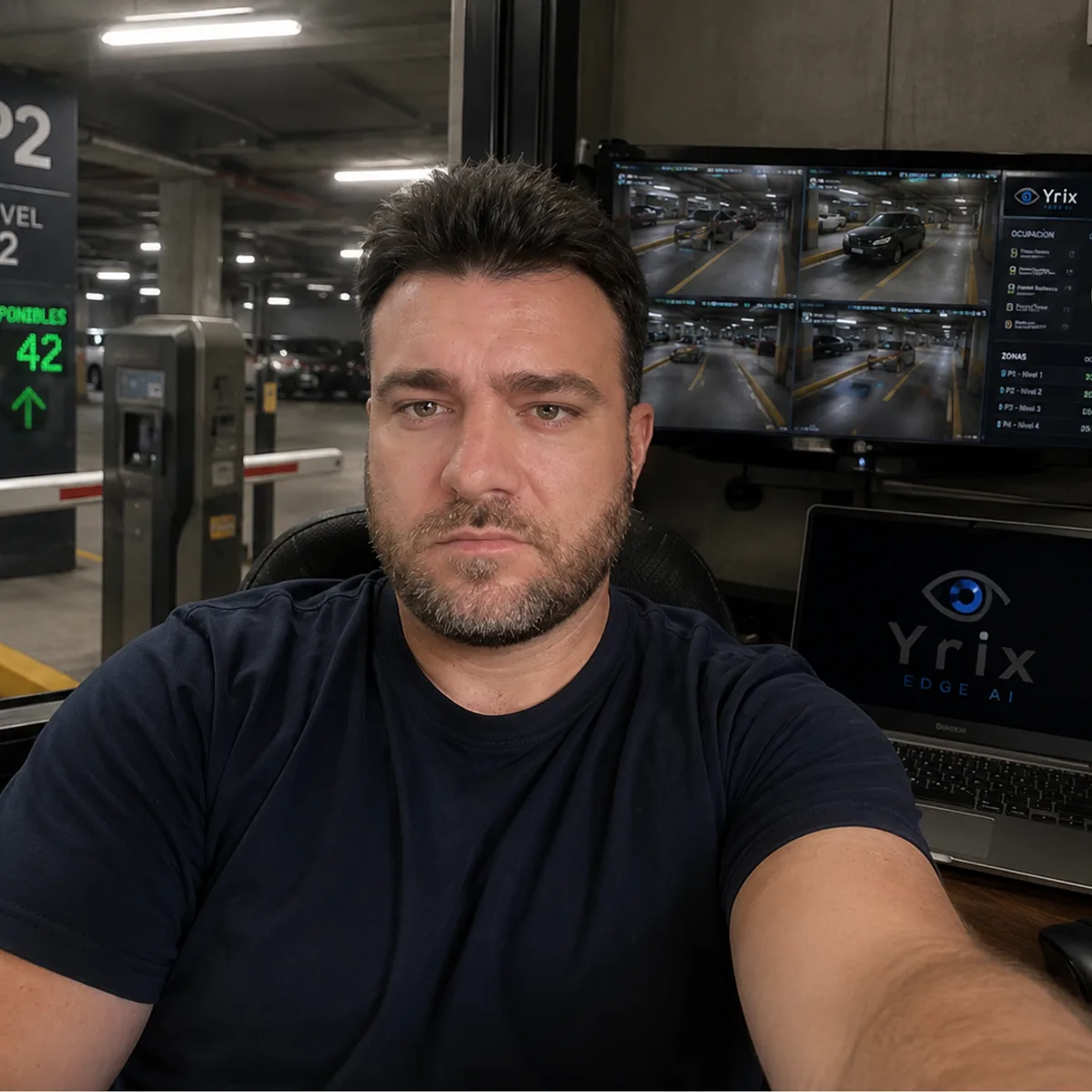
Daniel Bobadilla
Founder & CEO
ERP systems · computer vision
I've spent over 25 years working in technology, with experience for companies in the United States, Germany, Austria, United Kingdom, Spain and Argentina.
Part of that journey was years working with ERP systems: how an operation records what happens, collects payment, invoices and closes the month. That perspective, understanding the business end to end and not just what the camera sees, is what stands behind Yrix Park today.
Throughout that journey I specialized in systems where software connects with the physical world: computer vision, smart cameras, sensors, automatic visual data reading, and real-time control platforms.
Working with companies from different countries gave me a close-up view of how the most advanced markets operate: what level of automation they use, how they control their critical processes, and how they turn operational data into concrete decisions.
When I returned to the region, I found a very clear gap. Many solutions already used in other markets for vehicle control, access management, visual auditing and intelligent operation remain difficult to implement here. Not for lack of need, but because they tend to be expensive, complex systems or designed for very different operational realities.
Yrix was born to close that gap.
We built a computer vision solution applied to parking lots, designed to work in real scenarios: different operation sizes, tight budgets, existing infrastructure, and concrete needs for control, security and profitability.
Our vision is simple: that any parking lot can access advanced technology for recognition, automation and operational analytics, without depending on large investments or systems that are hard to maintain.
I'm a Systems Engineer, and over the last years I worked especially at the point where software, hardware and daily operation intersect. Yrix is the result of that experience applied to a concrete problem: helping each parking lot have more control, fewer losses, and better decisions.
Yrix Park in action
A walkthrough of the product: daily operation, cash desk and computer vision in one system.
Product presentation on YouTube
Who's behind every release
Yrix is the product of coordinated teamwork where every release passes through multiple hands before reaching a client. These are the areas that sustain day-to-day operations.
Computer Vision & AI
Design and training of the detection and recognition models that run on every Jetson. It's the technical heart of the product.
Product & Development
The web platform, the API, the operator dashboard, billing integrations and everything that connects the hardware to daily operations.
Quality & Testing
Continuous validation of every release against real parking scenarios. What reaches the client was tested beforehand, from plate reading to payment flows.
Operations & Support
Onboarding support and post-launch assistance. A new client is never left alone facing the system; the team is always on the other side.
How we build Yrix
Three principles behind every technical and product decision.
Accessible hardware
All the intelligence runs on a device the size of a shoebox that consumes 15 watts. No servers, no racks, no prior infrastructure.
Realistic operations
Designed for parking lots that exist today: with or without barriers, with or without a readable plate, with cashiers and clients who don't always have the app. Technology adapts to the site, not the other way around.
International standard, local costs
AI models at the level used in mature markets, but at a cost and complexity that any parking lot at any scale can sustain. That is the idea behind every product decision.
Want to see how this applies to your operation?
We'll show you the system live and review together which modules make sense for your case.